A pumping station generates data every second: voltage, current, power, energy, operating status, protection signals. The problem is not a lack of data; it is that this data never becomes a decision. Measurements sit on different screens, in different formats and disconnected from one another. The current state is visible, but a deterioration that builds up over weeks goes unnoticed.
Cinga was developed to close this gap. Known in full as the Cinga AI-Powered National Energy Analyzer and Decision Support System, it collects real-time data from energy infrastructure in the field, makes sense of it first through engineering and then through AI, and turns the result into a decision that the technical team, the field team and management can act on.
Data from the field
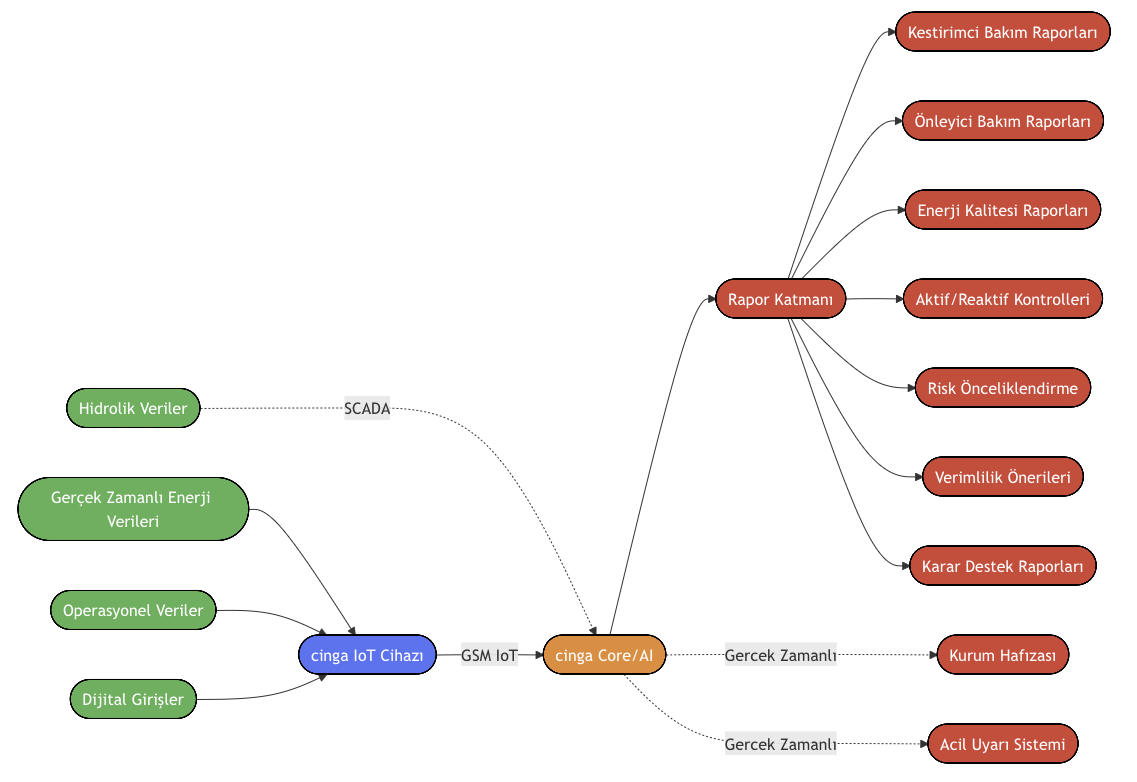
Everything starts in the field, at the switchboard feeding the pump or motor. Here, the Cinga Analyzer measures three-phase voltage and current, active, reactive and apparent power, power factor, frequency and energy readings. It also reads digital signals from contactors, protection relays and thermal overloads, so it answers not only "what does the measurement show?" but also "what state was the equipment in at that moment?". When process data such as flow, pressure and level can also be taken from the organisation's existing automation infrastructure, energy behaviour and the actual workload are read together.
This data reaches Ovoo's data backbone, Qapu, in real time over the cellular network and is processed in three layers:
- Base data: around 63 measurement parameters taken directly from the field.
- Synthesised data: around 60 parameters derived from raw measurements; the layer where the question shifts from "how many volts, how many amps?" to "what does this behaviour mean technically?".
- Trends and exposure: more than 60 outputs over daily, weekly and monthly windows. Does the problem appear at certain hours? Is it a one-off or becoming chronic? Is the same deterioration recurring? These questions are answered here.
AI that speaks your language
Cinga's most distinctive feature is that it talks to its users in their own language. An operations manager or field technician can ask Cinga AI, "Why is this pump drawing more current than last week?" or "Are we at risk of a reactive power penalty?". The answer is not produced from a memorised script but from that facility's current and historical measurements. Before answering, Cinga AI looks at the relevant device's real-time data, trends and scores.
Suv · energy and electrical health
Yes. Over the last seven days, average current has risen noticeably compared with last week; at the same hours the power factor dropped and the current imbalance between phases grew. Voltage is within TS EN 50160 limits, so the increase is coming from the pump itself, not from the grid.
Recommendation: A mechanical check of the pump and motor bearings. The maintenance risk score has moved to "rising"; a site inspection can be scheduled this week.
Every question first passes through a router that works out which domain it belongs to, and then reaches the expert for that domain: Suv for water and pumping stations, Kün for solar power plants, Temir for industrial facilities and Tarıg for agricultural irrigation. Within its domain, each expert examines energy analysis, reactive power and penalty risk, power quality, electrical health, anomalies and root causes. These experts were trained specifically for Türkiye by Turkish engineers; underpinning them are the TS EN 50160 standard, Türkiye's grid structure, reactive energy rules and the measurements our own devices collect in the field.
We use AI not as a black box that passes judgement, but as a layer that explains. Raw data first goes through engineering steps: synthesised parameters are calculated, window and trend analyses are produced, and rules and scores are prepared. The AI looks at this prepared picture. It combines signals that look weak on their own, interprets the direction and speed of a deterioration, and turns the finding into a plain expert commentary and an actionable recommendation. Every commentary states which signals and which trend it is based on. The final word still belongs to the engineer who knows the field.
Reliable measurement, tamper-proof records
An analysis is only as reliable as the measurement it rests on. Every Cinga device is calibrated and goes into the field with calibration accredited by TÜRKAK, the Turkish Accreditation Agency. As a result, every value from the field is part of a traceable, verified measurement chain.
On the analysis side, the reference is the literature. Cinga's entire system infrastructure and AI experts were built and trained on the basis of TS EN 50160, the benchmark for voltage quality in Türkiye, and EN 61000-4-30 is taken into account in measurement methods. Cinga AI's standards compliance expert states clearly which standard limit a measurement is assessed against and what the result means. On the reactive energy side, the limits in force in Türkiye are applied.
The final link is the record. Data reaching Qapu is stored chained together in a blockchain structure; if a record is altered afterwards, the chain reveals it. This means that in an energy problem, such as an outage, a voltage disturbance or a reactive power penalty dispute, Cinga's records give the organisation technical evidence and a legal basis whose integrity can be verified.
Calibrated measurement
Devices go into the field with TÜRKAK-accredited calibration
TS EN 50160
Every measurement is assessed against the standard's limits
Blockchain record
Records are chained together and cannot be altered afterwards
Legal basis
Verifiable technical evidence in a dispute
Not a single score, but scores read together
The reality of the field does not fit into a single score. The same pump may carry a high maintenance risk while sitting at a medium level for power quality. That is why Cinga Score assesses several areas:
- Maintenance risk: brings to light, early on, equipment that shows signs of deterioration but has not yet failed.
- Power quality: shows the health of the electrical environment feeding the equipment and its effect on equipment life.
- Efficiency and operating behaviour: catches equipment that keeps running but is starting to become inefficient.
- Intervention priority: goes beyond "is there a problem?" to answer "which one should we look at first?".
- Management summary: shows at a glance which facilities are more vulnerable, without losing technical detail.
Output at the right level for everyone
From the same data, the technical team gets detailed charts and technical commentary, the field team gets a prioritised checklist and action notes, and management gets a plain summary of risks and priorities. Unusual situations are reported instantly; recurring events, score changes and behaviour patterns are recorded. This way, how a pump has behaved over the years stays in the organisation's memory, not in one employee's.
Cinga does not replace existing SCADA and automation systems; it works alongside them. It can take data from them, run analyses on the data it collects itself, and pass the scores and summaries it produces on to higher-level systems.
Tested in the field
We develop Cinga in the field, not in the lab. Each of our experts was tested and trained in the real field of its own domain.
Since February 2026, we have been running our first trials with KOSKİ at KOSKİ's pumping stations; this is where Suv grew up. On the industrial side, Temir was tested at Koyuncu's chlor-alkali plant, an energy-intensive production environment. Kün, the expert for solar power plants, was tested at INSOS's solar test sites. Tarıg, the expert for agricultural irrigation, was trained together with irrigation associations, using data from their pumps.
Suv
KOSKİ pumping stations
First field trials, since February 2026
Temir
Koyuncu chlor-alkali plant
Energy-intensive industrial facility
Kün
INSOS solar test sites
Solar plant generation and power quality
Tarıg
Irrigation associations
Agricultural irrigation pumps, together with the associations
Real-time data from real facilities, under real operating conditions, makes both our analysis layers and our AI experts a little more mature every day. We learn how a pump behaves differently in the morning and in the evening, and what signs a fault gives before it happens, not at a desk but in the field.
It starts with a spark
In Central Anatolia, cinga is the word for an electric spark. Every measurement in the field is like a spark: small on its own, but read correctly, it is the first sign of a fault, a loss or an opportunity. Cinga's job is to see that spark in time and to tell the organisation, in its own language, what it needs to do.